
Every strategy on this site assumes one thing first: you can stay in the game long enough for your decisions to matter. Bankroll management is the system that protects that runway. It does not make a losing bet win; it controls how much any single result can damage the money you deliberately set aside for betting.
The foundation
Why bankroll management matters
Variance is unavoidable. A sound process can still produce a losing week, month, or longer stretch, especially in sports betting and poker. The goal of bankroll management is not to eliminate losses; it is to keep normal losses from ending your ability to continue.
Protects capital
Small stakes limit the damage from ordinary losing streaks.
Scales naturally
Bet size can shrink during a downswing and grow after genuine bankroll growth.
Reduces emotion
Pre-set sizing removes “this one feels bigger” from the decision.
Buys time
A longer runway gives a real edge, if one exists, more time to show up.
Your betting bankroll should be completely separate from rent, bills, savings, debt payments, and other essential expenses. See our Responsible Gambling Guide for budgeting and limit-setting fundamentals.
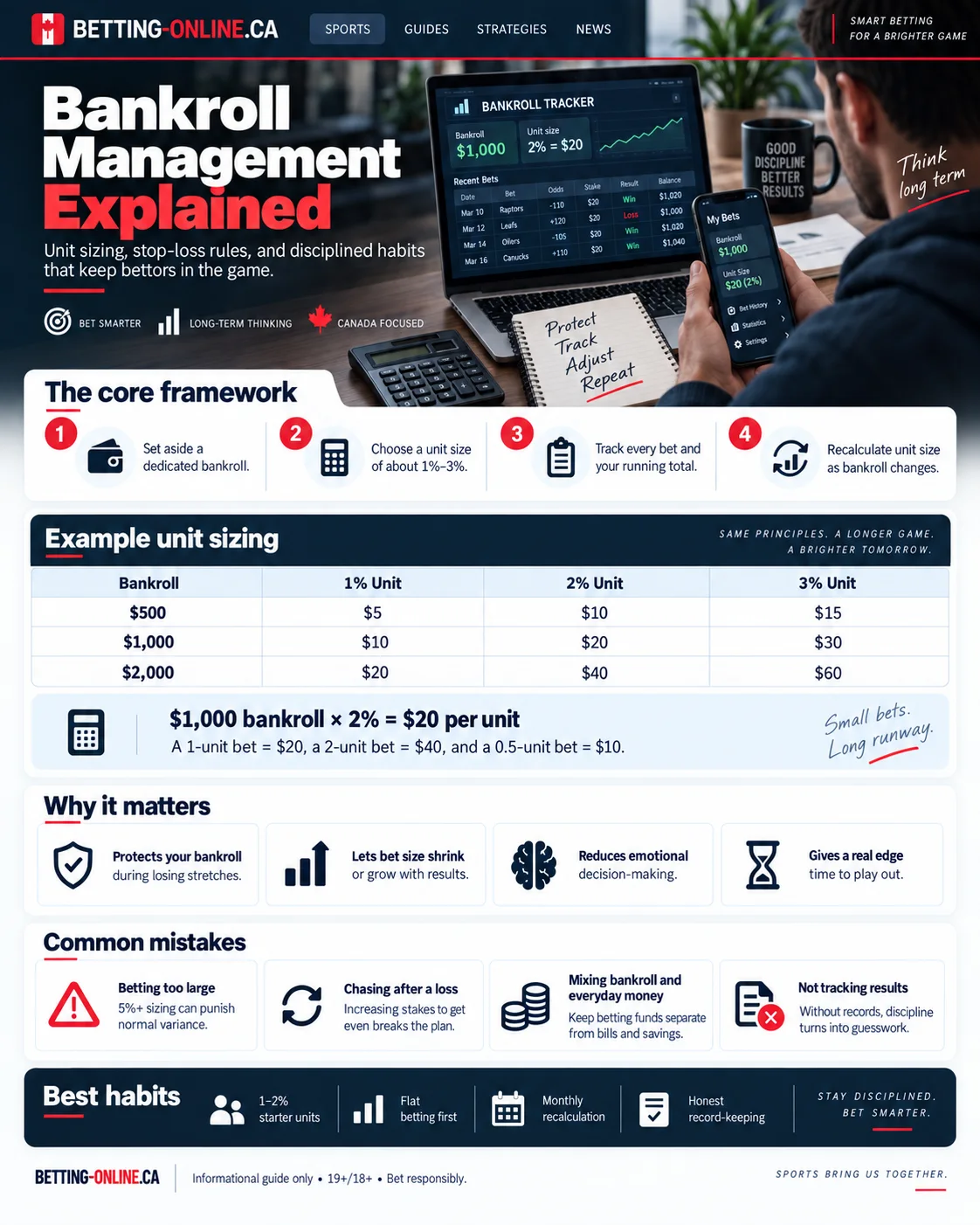
Core framework
Four rules that keep sizing disciplined
Set the bankroll
Choose a fixed amount you can afford to lose in full without affecting essential finances.
Choose a unit
A conservative starting unit is commonly around 1–2% of the current bankroll.
Log every bet
Track stake, price, result, profit/loss, and the running bankroll total.
Recalculate
Review the bankroll periodically and scale unit size up or down deliberately.
A $1,000 bankroll at three common unit sizes
| Bankroll | 1% unit | 2% unit | 3% unit |
|---|---|---|---|
| $500 | $5 | $10 | $15 |
| $1,000 | $10 | $20 | $30 |
| $2,000 | $20 | $40 | $60 |
A 1-unit bet is $20, a 2-unit bet is $40, and a 0.5-unit bet is $10. The percentage-not the excitement of the pick-sets the base size.
Why smaller units usually win the discipline battle
A losing streak of five, eight, or ten bets can occur even with a sound process. Large units compound damage quickly, while small units leave more room for normal variance.
Why oversized units become dangerous
At 5% per bet, a routine downswing can remove a large share of the bankroll before you have enough data to judge whether the strategy itself is good or bad.
Staking plans
Flat, proportional, and fractional Kelly
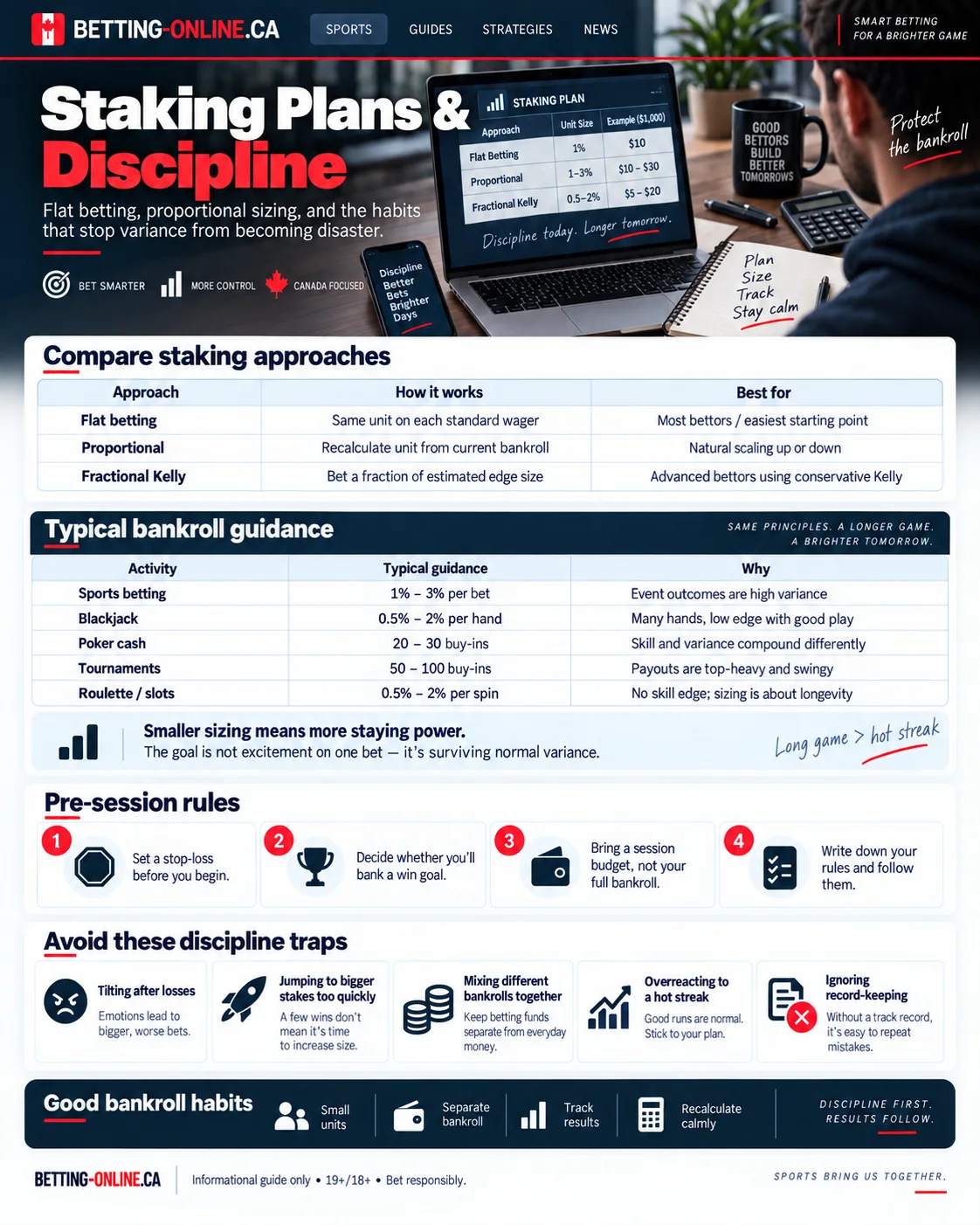
The right staking plan should be understandable enough that you can follow it during both winning and losing stretches. For most bettors, simple flat or proportional sizing is easier to execute consistently than a model that depends on estimating your edge precisely.
Three common approaches
| Approach | How it works | Strength | Main caution |
|---|---|---|---|
| Flat betting | Use the same standard unit for each normal wager. | Simple and easy to audit. | Fixed dollars can become too large after a major downswing. |
| Proportional | Recalculate the unit from the current bankroll on a set schedule. | Automatically scales down and up. | Requires disciplined review, not constant emotional resizing. |
| Fractional Kelly | Bet a fraction of a Kelly-sized wager based on your estimated edge. | Links stake size to the quality of the estimated edge. | Bad edge estimates can produce bad sizing; full Kelly is aggressive. |
Because bettors can overestimate their own advantage, many experienced users prefer fractional Kelly rather than full Kelly. If you cannot estimate an edge reliably, a small fixed unit is the cleaner default.
Before the session
Set the rules while you are calm
Pre-set a stop-loss
Decide before starting how much you are willing to lose in that session. Treat it as a hard limit, not a suggestion to reconsider when emotions rise.
- Write the number down
- Do not increase stakes to recover losses
- Stop when the limit is reached
Decide how to handle a good run
A win goal can prevent a hot streak from turning into uncontrolled stake growth. The important part is deciding the rule in advance rather than improvising mid-session.
- Keep standard units unchanged
- Bank a portion if that is your rule
- Avoid “house money” thinking
Different games, different variance
Bankroll guidance by betting activity
The principle is universal-keep any one result from doing disproportionate damage-but the practical numbers differ because each activity has a different variance profile.
| Activity | Typical guidance | Why it differs |
|---|---|---|
| Sports betting | 1–3% of bankroll per bet | Individual event outcomes carry high variance. |
| Blackjack | 0.5–2% of session bankroll per hand | Many hands per session can compound swings even with correct basic strategy. |
| Poker cash games | 20–30 buy-ins | Skill and player-vs-player variance compound differently. |
| Poker tournaments | 50–100 buy-ins | Top-heavy payouts create long stretches without a large cash. |
| Roulette / slots | 0.5–2% of session bankroll per spin | There is a fixed house edge, so sizing is mainly about longevity and volatility tolerance. |
See our Poker Strategy guide for why poker needs deeper bankrolls and Slots: RTP & Volatility for how volatility should influence session sizing.
When results go against you
How to respond to a downswing
Do this
- Recalculate the unit from the smaller bankroll
- Keep the same underlying process
- Review the record over a meaningful sample
- Separate strategy problems from normal variance
Do not do this
- Double the next bet to get even
- Increase units because you are “due”
- Mix essential money into the bankroll
- Judge a long-term strategy from a handful of bets
If you feel pressure to recover losses quickly, stop betting and review your limits. Our Responsible Gambling Guide and self-exclusion and support resources explain practical next steps.
Record keeping
Track results honestly
Memory overweights memorable wins and undercounts the steady accumulation of smaller losses. A simple ledger gives you a more objective view of what is actually happening.
Five columns worth tracking
| Date | Bet / session | Stake | Result | Running bankroll |
|---|---|---|---|---|
| Sep 1 | Example wager | 1 unit | +0.91 units | Update after settlement |
| Sep 3 | Example wager | 1 unit | −1.00 unit | Update after settlement |
Stake
Record dollars and units so sizing discipline is easy to audit.
Profit / loss
Track net outcome, not only whether the selection won.
Running total
Know the current bankroll before your next scheduled recalculation.
Notes
Flag mistakes, changed prices, or rule-breaking so patterns are visible later.
Common mistakes
Discipline traps that damage bankrolls
Betting too large
Oversized units make ordinary variance far more destructive.
Chasing after losses
Increasing stakes to recover quickly turns a planned system into reactive betting.
Mixing bankroll and bills
Betting funds should remain separate from money needed for everyday life.
Ignoring records
Without a ledger, it is easy to misremember results and repeat sizing mistakes.
Overreacting to a hot streak
A few wins are not evidence that your risk tolerance or true edge suddenly changed.
Mixing different-risk games
Poker, sports betting, and slots have different variance profiles and should not automatically share one sizing rule.
Simple starting plan
A conservative framework for beginners
You do not need advanced formulas to start managing a bankroll well. A small, repeatable system is more useful than a sophisticated system you abandon during the first losing streak.
Bottom line
Bankroll management gives your process a chance to survive
Bankroll management does not create an edge on its own. What it does is make sure that a genuinely sound strategy is not wiped out by an entirely ordinary downswing before enough bets or sessions have occurred to evaluate it fairly.
Those three habits matter more than any single “big bet.” If you want the market-analysis side next, continue with our Sports Betting Strategy guide.