
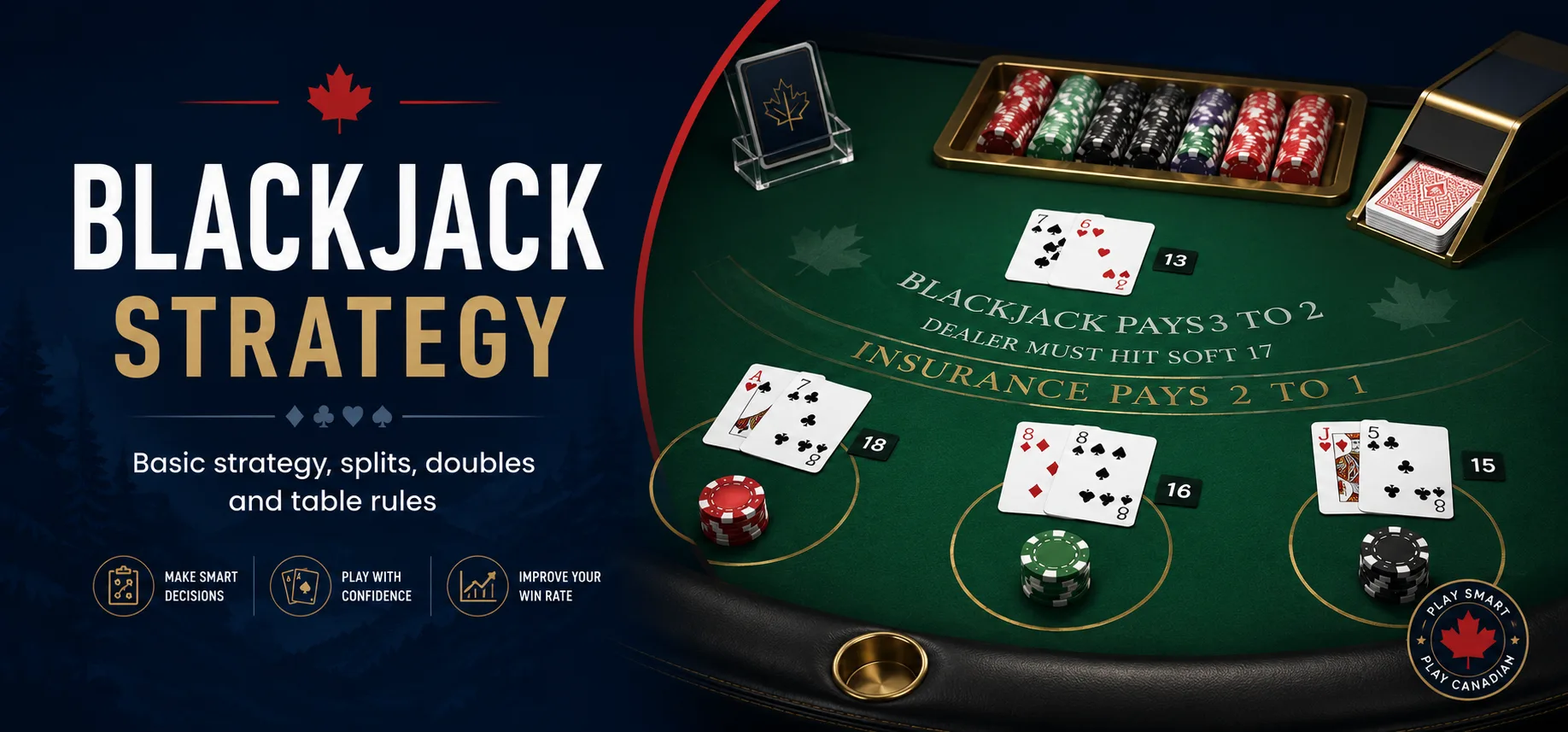
That is the house edge range you can approach with solid basic strategy at fair tables.
Always check the blackjack payout first. It is the most costly rule downgrade.
It matters more than intuition, betting systems, or guessing how the next card will land.
You are not trying to predict cards - you are trying to make the least costly decision every time.
Play the math
Blackjack rewards discipline. The right move often feels boring, but boring is profitable over time.
Know your table rules
A perfectly played hand at a weak 6:5 table can still be worse than a slightly misplayed hand at a strong 3:2 table.
Avoid side-bet drift
Perfect Pairs and 21+3 can be fun, but they usually carry a much higher house edge than the main hand.
Blackjack strategy in one minute
If you want the short version before diving into the charts, focus on these principles first. They cover the highest-impact ideas on most tables.
- Always prefer 3:2 blackjack tables over 6:5 tables. That one rule check matters more than most individual hand decisions.
- Stand when the dealer is weak on hard 12 through 16 against dealer 4, 5, or 6. Let the dealer's bust risk do the work.
- Double hard 10 and hard 11 aggressively against weak-to-medium dealer upcards. Those are your best money-making spots.
- Treat soft hands differently from hard hands. A soft 17 or soft 18 can often be hit or doubled because the Ace protects you from busting on the next card.
- Never split 10s, and always split Aces and 8s in standard basic strategy.
The 5 core actions
Every blackjack decision is built around five actions. Knowing what each one does - and when it tends to appear - makes strategy charts much easier to remember.
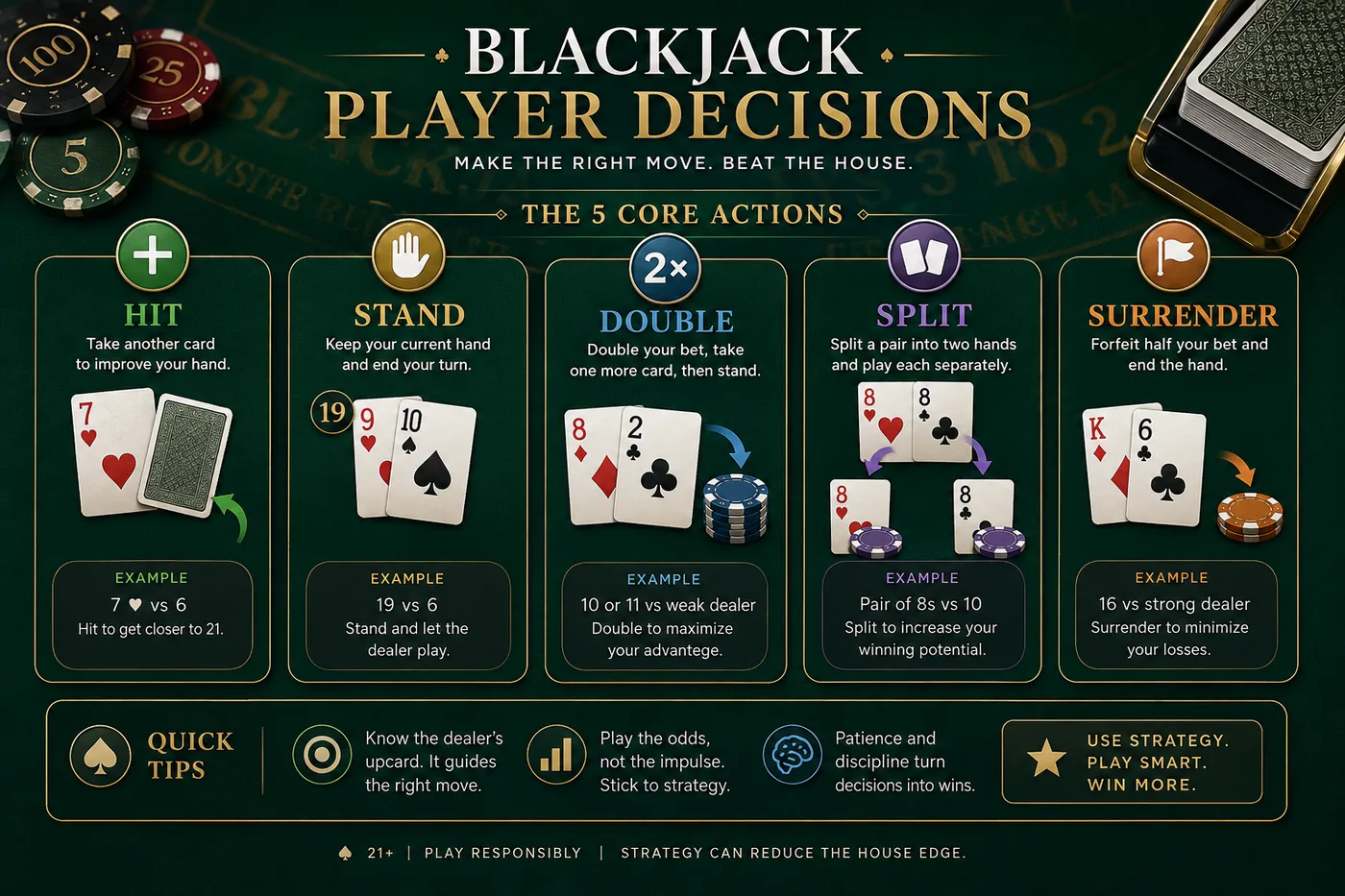
Hit
Take another card because your current total is too weak to win often enough by standing.
Typical example: hard 8 or lower, or hard 12 against a dealer 2 or 3.Stand
Keep your total and force the dealer to finish the hand. This is strongest when the dealer is in a bust-prone spot.
Typical example: hard 13 to 16 against dealer 2 through 6.Double
Double the wager, take exactly one more card, and stand. Best used when one extra card can create a very strong hand.
Typical example: hard 10 against dealer 2 through 9; hard 11 against almost everything.Split
Turn a pair into two separate hands. Some pairs improve dramatically when split; others should almost never be touched.
Typical example: always split Aces and 8s; never split 5s or 10s.Surrender
Give up the hand immediately and lose half your stake. It is a niche but mathematically correct escape in very bad spots.
Typical example: hard 16 against 9, 10, or Ace when late surrender is available.Basic strategy by hand type
Basic strategy means the mathematically best play for every common hand against every dealer upcard. Learn it in three buckets - hard hands, soft hands, and pairs - and the full chart becomes much easier to remember.
Hard hands
Hard totals carry the most meaningful stand-vs-hit decisions because you can bust immediately on the next card.
- Hard 8 or less: always hit.
- Hard 9: double against dealer 3 through 6, otherwise hit.
- Hard 10: double against 2 through 9, hit against 10 or Ace.
- Hard 11: usually double against any upcard.
- Hard 12: stand against 4 through 6, otherwise hit.
- Hard 13-16: stand against 2 through 6, otherwise hit.
- Hard 17+: stand.
Soft hands
Soft hands contain an Ace counted as 11, so you can play more aggressively because one extra card cannot bust you outright.
- Soft 13-14 (A,2 / A,3): double against 5 or 6, otherwise hit.
- Soft 15-16 (A,4 / A,5): double against 4 through 6, otherwise hit.
- Soft 17 (A,6): double against 3 through 6, otherwise hit.
- Soft 18 (A,7): stand against 2, 7, or 8; double against 3 through 6; hit against 9, 10, or Ace.
- Soft 19+: usually stand.
Pairs
Pairs create the most memorable split rules because the correct play often ignores the combined total and focuses on how the two hands improve separately.
- Always split: Aces and 8s.
- Never split: 5s and 10s.
- 2s / 3s: split against 2 through 7 if DAS is allowed on many charts; otherwise more conservatively against 4 through 7.
- 4s: usually split only against 5 or 6, often when DAS is available.
- 6s: split against 2 through 6.
- 7s: split against 2 through 7.
- 9s: split against 2 through 6 and 8 through 9; stand against 7, 10, or Ace.
Why dealer 4, 5, and 6 matter so much
Those are the dealer's weakest upcards because house rules force the dealer to keep drawing on low totals. That means the dealer busts more often from those positions than from 7, 8, 9, 10, or Ace. Whenever your chart says "stand with a mediocre hand," it is usually because the dealer's bust risk is doing the heavy lifting.
Why soft hands feel different
Soft totals are easier to play aggressively because the Ace gives you a safety net. Soft 18 might look "good enough," but against strong dealer upcards it is often not strong enough to win by standing, so the chart tells you to hit or double instead.
Table rules that impact your edge
Not all blackjack tables are equal. Rule differences change the house edge before the first card is even dealt, so they deserve as much attention as your strategy chart.

| Rule | Best version | Why it helps | If you get the weaker version |
|---|---|---|---|
| Blackjack payout | 3:2 payout | Full value on natural blackjacks. This is the single biggest quality marker on any table. | 6:5 payout raises the house edge by about 1.4 percentage points - a major downgrade. |
| Dealer on soft 17 | Dealer stands | The dealer takes fewer extra cards, which slightly improves your long-run return. | Dealer hits soft 17 adds roughly 0.2 percentage points to the edge. |
| Double after split | Allowed | Gives you more profit potential on newly created hands and makes some splits more valuable. | Not allowed costs the player around 0.1 to 0.15 percentage points. |
| Surrender | Late surrender available | Lets you cut losses in a few of the most painful spots. | No surrender removes a small but useful strategic tool. |
| Deck count | Fewer decks | Usually slightly better for the player, all else equal. | More decks increase the edge modestly and make strong rules even more important. |
Look for 3:2 blackjack, dealer stands on soft 17, and double after split. That is a strong starting point before you check anything else.
Live blackjack often publishes table rules clearly in the info panel. Use that info panel before sitting down instead of discovering a weak rule after a few hands.
Card counting does not meaningfully apply to standard RNG blackjack because the deck is effectively reset each hand. Online profit mostly comes from rules + correct play.
Common mistakes that erase your edge
Most blackjack losses are not caused by one dramatic error. They come from a series of small, repeated leaks that quietly raise the effective house edge.
- Playing 6:5 tables without noticing. This is one of the most expensive mistakes in modern blackjack and it is easy to avoid with a five-second rule check.
- Standing on soft totals because they feel "safe". Soft 17 and soft 18 often need more aggression, not less.
- Taking insurance without a counting edge. For ordinary players, insurance is a negative-value side wager dressed up as "protection."
- Splitting 10s for entertainment. A made 20 is already one of the strongest hands in blackjack. Splitting it usually converts a great position into two weaker ones.
- Letting side bets dominate the session. They can be fun, but they are usually much worse mathematically than the base game.
- Ignoring bankroll sizing. Even a low-edge game can feel brutal when stakes are too high for the session budget.
Best follow-up skill
Once your strategy chart feels automatic, the next biggest improvement is bet sizing. See Bankroll Management for a practical session plan.
Compare with other table games
If you want to compare blackjack with roulette and baccarat, start at Casino Games Explained or browse our Table Game Reviews.